
"When the battery dies, you could be forced to throw away a perfectly good car!" This lament has been hurled at everything from early Prius hybrids to modern battery-electric vehicles, despite almost every manufacturer warrantying their batteries to retain 70 percent of their original battery capacity after a period of 8–10 years and 100,000–175,000 miles. Well, as the earliest Ford Mustang Mach-Es have been celebrating their fifth birthdays, Ford shared some encouraging statistics on the aggregate fleet battery health of the model's "Class of 2021."
By the Numbers
-
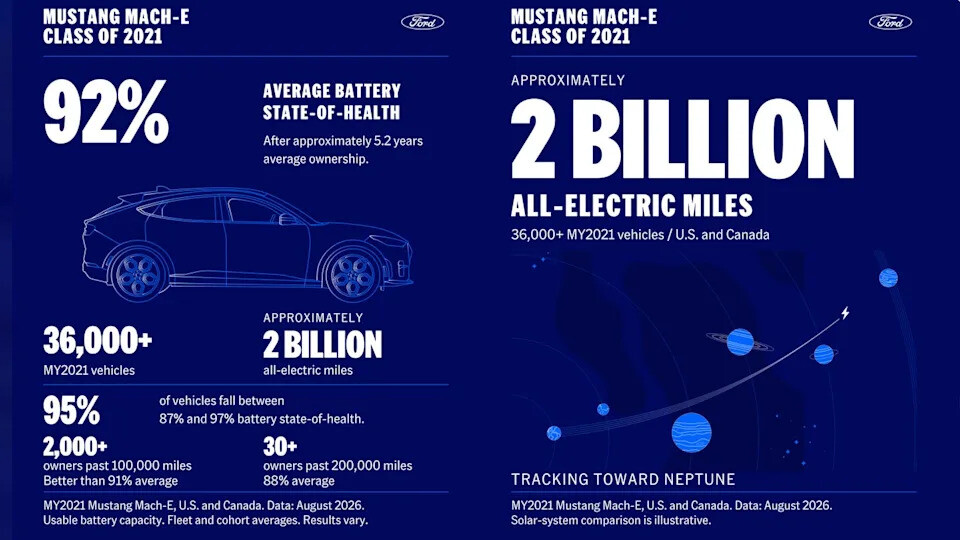
Number of vehicles: 36,000 (U.S.A. & Canada)
-
Fleet cumulative distance traveled: 2+ billion miles
-
Average ownership period: 5.2 years
-
Average battery state-of-health: 92% of original*
-
100,000-miles+/retained health: 2,000+ cars/91%
-
200,000-miles+/retained health: 30+ cars/88%
*As reported by the onboard battery management system—this is not a lab-measured capacity test result.
Ford - MotorTrend
Obtaining the Numbers
It came to Ford's attention that one of its more intrepid Mach-E drivers, David Blenkle, had racked up more than 400,000 miles on his 2022 Mustang EV, retaining a high percentage of the battery's original capacity. To determine whether Blenkle's Mach-E was an outlier, Ford's battery team took advantage of the Mach-E's inherent connectivity and queried the entire fleet to determine mileage and battery health, preparing a dataset for the 2021 model fleet.
Tightly Clustered
Perhaps more important than that 92-percent usable-capacity state of health figure (as measured by the cars' onboard system, not a lab) is the fact that of the 36,000 cars reporting data, 95 percent of them fall between 87 and 97 percent—that's well above the 70 percent threshold where Ford's warranty replacement might be triggered. Ford didn't share any statistics on warranty replacements, and we could find no such public disclosures, though there was a service action involving inspection and possible replacement of suspect high-voltage battery modules.
What About Other EVs?
Tesla's 2024 Impact Report reported that Model 3 and Model Y vehicles having covered 200,000 miles were averaging 80 percent capacity. Recurrent is a third-party data aggregation group that customers can opt in to share their battery data (as MotorTrend did with its 2023 Lightning long-term test car). Its database includes 50,000 vehicles and 1 billion cumulative miles traveled and reports average range retention of 95 percent after five years (but notes that "range retention" is not necessarily the same as percent of original capacity, because manufacturers can update software that alters range reporting). A potentially useful Recurrent statistic for our purposes here: Of 2022 and newer vehicles across all makes and models, the reported battery replacement rate is 0.3 percent, not including major recalls.
While Ford, Tesla, and others have vested interests in saying their EVs last a long time, when all taken together, it's clear widespread premature battery death simply isn't a problem.
Ford - MotorTrend
How To Stretch Battery Life
-
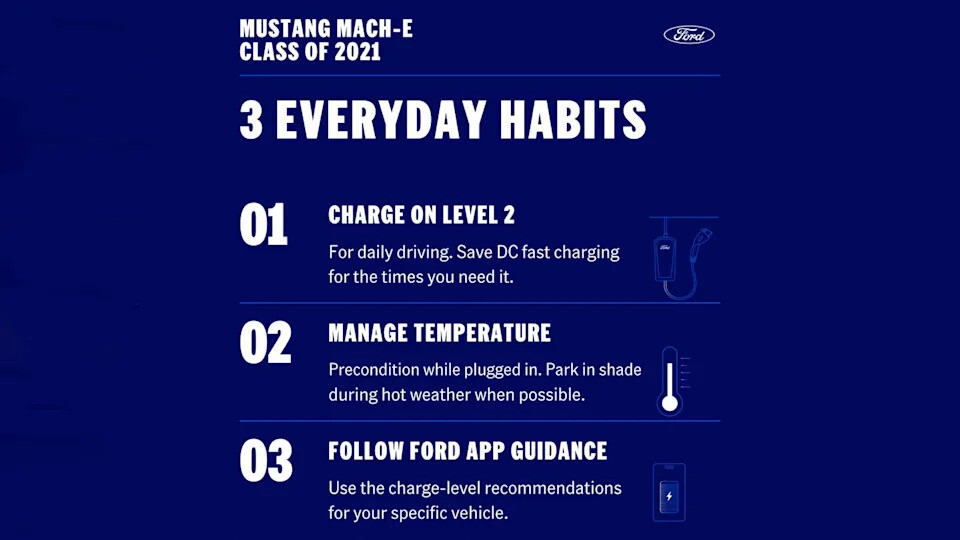
Use Level 2 AC charging for daily driving, limiting DC fast-charging for long-distance trips.
-
Follow the manufacturer's recommended upper charging limit. This is often 80 or 90 percent, but consult your manufacturer's app or dashboard display, as some new lithium-iron-phosphate (LFP) batteries prefer occasional charges to 100 percent to calibrate the battery monitoring system.
-
Avoid running the battery very low and try not to leave it at a low state of charge for long periods.
-
Help manage battery temperature in extreme hot or cold weather by preconditioning the battery while plugged in before driving off, preconditioning before charging when possible, and by parking in the shade during hot weather or in protected spaces during the cold.
Help Dispel the Battery-Death Myth
So the next time you're at a dinner party or gathering and someone hauls out that old "EV batteries don't last" myth, you can help set the record straight—EVs seem to be holding up way better than the doubters predicted.